My Cat’s Response to “No” Revealed Her Personality Type
- Sue Leonard

- Jul 4
- 3 min read
Updated: 4 days ago
I avoided the Myers-Briggs category of Thinking versus Feeling for a long time because, unlike the other preferences, there is no way of knowing how cats make decisions.
Then one sleepless night, a thought struck me: if we could understand how cats make decisions, what would that look like?
In Myers-Briggs terms, people who prefer Thinking tend to evaluate choices using objective principles. People who prefer Feeling tend to weigh decisions based on values and human impact. Both use logic and emotions; they simply have different criteria for making decisions.

One of my favorite examples comes from my MBTI administrator training.
A dry cleaner is closing her store at 6:00 PM. The door is locked. She is about to turn the sign from OPEN to CLOSED when a frantic customer runs up through a pouring rainstorm carrying a single garment.
The dry cleaner has a decision to make.
A person with a Thinking preference might say: "The store closes at six. It's already 6:01. Rules are rules."
She might continue reasoning: "If I let this customer in, others may expect the same treatment. What if she wants to pick up several items? What if she stays until the rain stops? That's why we have closing times."
This person is making her decision based on rules and impersonal criteria. People making a decision using a thinking preference can seem to be tough-minded.
A person with a Feeling preference might notice the rain and the worried expression on the customer's face. "It's only one minute after six. It's pouring rain. The customer's clothing may get ruined if I don't help her." She unlocks the door, lets the customer in, and quietly flips the sign to CLOSED anyway. She might justify her decision by thinking: "The weather may have made her late. Good customer service matters. Helping her is the right thing to do."
This person is basing her decision based on personal and social values. People making a decision using a feeling preference can seem empathic and people-oriented.
Neither decision is inherently right or wrong. Both involve logic. The difference is the criteria used to make the decision.
So naturally, this led me to wonder:
What criteria do cats use when they make decisions?
Since no one has asked cats directly, I decided to invent some possibilities.
The Cat Commandments
Thou shalt remain clean at all times.
Thou shalt train thy human to cater to thy every wish.
Thou shalt always be cute and alluring.
Thou shalt evaluate every object as a potential cat toy, especially those of human value.
Thou shalt wait until thy human enters REM sleep before demanding attention.
Thou shalt awaken thy humans before sunrise when breakfast is desired.
Thou shalt sit upon whatever thy human is currently paying attention to.
Now that we know the Cat Commandments, we can theoretically determine whether a cat prefers Thinking or Feeling. Or at least pretend we can.
Part of my motivation for tackling this topic came from Misty. Misty seemed to make decisions based on the impact they had on her humans. She was the rare cat who actually responded to the word No. Not only did she stop what she was doing, but she would look up with an expression that seemed to say: "Oh, Mommy, I didn't mean to upset you."
Then she would immediately stop.
Casey was a close second. Most of the time he obeyed, but occasionally you could almost see the internal debate: "I'd really like to continue doing this, but my human won't approve." Reluctantly, he would usually stop.
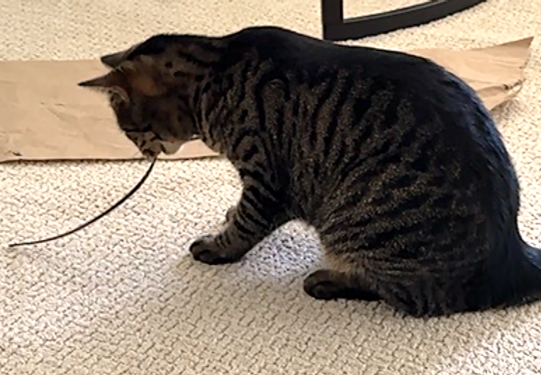
The other cats? Not so much. Their reactions suggested a different thought process: "Interesting opinion, Human. However, Commandment Number Four clearly states that every object must be evaluated as a potential cat toy."
Based on this highly scientific methodology, I would classify Misty and Casey as Feeling cats and the others as Thinking cats.
Of course, this analysis is completely whimsical.
I have absolutely no scientific evidence to support any of it.
But perhaps it illustrates how Myers-Briggs describes Thinking and Feeling preferences. And maybe it will inspire you to watch your own cat the next time you say No.
Does your cat stop because it cares about your feelings?
Or does it simply decide that Cat Commandments take precedence?

Comments